Brian S, CEO SayIntentions.AI
May 2026
This is not “look, we added airplanes.” This is a design philosophy article: an explanation of what we believe AI-controlled traffic in a flight simulator should be, and why we built it the way we did.
If you’ve ever wondered why SayIntentions.AI traffic behaves differently than other traffic systems, or why this kind of system has the cost structure it does, this is the answer.
The 3 Roles of a Flight-Simulation Traffic System
Before you can build the right thing, you have to be honest about what you’re actually trying to accomplish.
Our design dictates that a traffic system in a flight simulator has three jobs:
- Put aircraft in plausible real-world places at plausible real-world times.
- Sequence and control those aircraft through ATC.
- Animate them convincingly inside imperfect simulators.
That’s it. Everything else is downstream of those three requirements.
The challenge is that many traffic systems are very good at job one, but much less involved in others. They show you dots. Realistic-looking dots. Useful dots, even. But the dots often don’t talk to ATC. The dots don’t hold short for you. The dots don’t respond to your position, your clearance, your speed, or the flow of the airport around you.
That can still be valuable. For some simmers, seeing real-world aircraft around them is exactly the goal.
But it is not the kind of traffic system we set out to build.
While the moving wallpaper is impressive, useful, and sometimes exactly what someone wants, it’s not something ATC can truly manage.
The Wrong Starting Point: ADS-B
ADS-B is an obvious answer to the traffic problem. It gives you live aircraft positions. It looks precise. It matches the real world tick by tick. It sounds like the right foundation. And honestly, for some use cases, it genuinely is.
If what you want is to watch real-world traffic out your virtual window, ADS-B injection is a perfectly reasonable tool. It requires relatively little infrastructure, it can be inexpensive to run, and it does that specific job well.
But it is the wrong foundation if you want to participate in that traffic system.
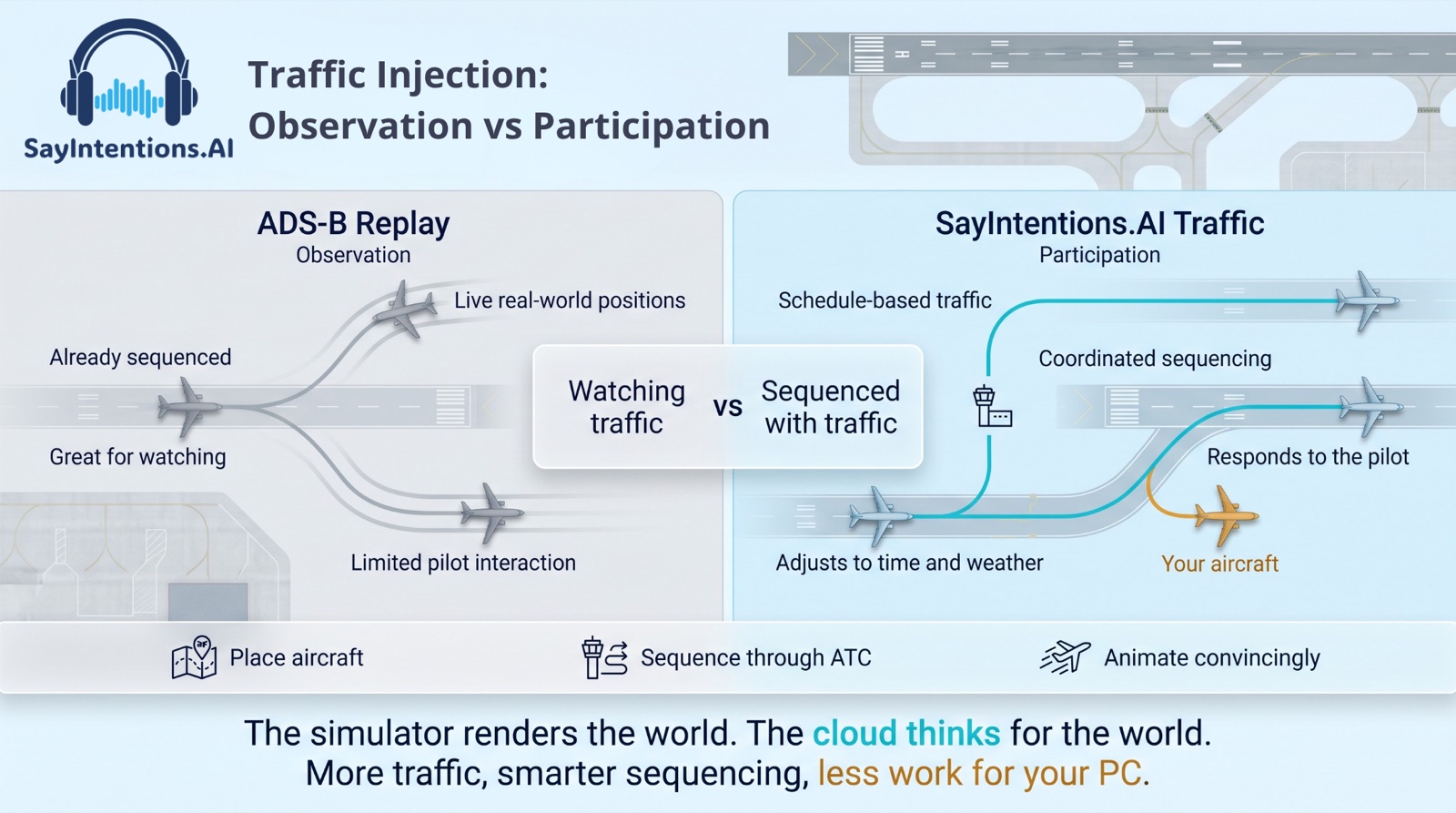
Here’s why. Every aircraft you see on an ADS-B feed has already been sequenced by real-world ATC. The spacing you’re seeing on screen? That happened. The sequence from base to final? Already determined. The ground order at the gate? Already resolved. The real world handled it, and you’re watching the result.
That means there’s no natural room for the most important part of the simulation – You! If three aircraft are already perfectly spaced on the ILS in real life, and you’re a fourth aircraft trying to fly the approach in the simulator, the system has nowhere meaningful to put you. ATC becomes theatrical. It can narrate what’s already happened, but it cannot fully run the operation, because the operation has already been decided by someone else.
The more tightly a traffic system follows live ADS-B, the less freedom ATC has to reshape the operation. ADS-B fidelity and ATC authority pull in opposite directions.
There are also practical problems. ADS-B coverage is inconsistent globally: strong in North America and Europe, patchy in many other places. Tick-by-tick position updates are expensive for FPS performance. And none of it naturally adjusts for the fact that you’re flying at 2am on a Tuesday, or in weather that doesn’t match the current real-world METAR. The traffic doesn’t adjust to the simulation!
ADS-B is excellent for observation.
It is not ideal for participation.
The Better Foundation: Gate-to-Gate Schedule Data
The alternative is to start from real-world commercial schedule data, subsidize with synthetic schedules where data is thin, and then let the aircraft become their own independent entities inside the simulator.
Rather than asking, “Where is this aircraft right now, on Earth, in real life?”, we ask, “Where would this aircraft be, given the airline schedule, the time of day, the airport, and the current simulated conditions?”
That shift changes everything.
Once traffic is generated from schedule data rather than replayed from ADS-B positions, each aircraft can become that independent AI-controlled entity. It has intent. It has a route. It has a sequence in the departure queue. And critically, it can be moved, held, expedited, or rerouted by ATC.
That means:
- Traffic can respond to ATC.
- Traffic can respond to you, the pilot.
- ATC can sequence traffic around your position and speed.
- Airports can adjust to your chosen time of day.
- Routes and procedures can adjust to simulated weather.
- We can increase traffic density at airports where real-world data is thin.
- ATC remains genuinely in control of the operation.
The goal is not to replay the real world perfectly. The goal is to create a believable world that behaves correctly, one you can actively participate.
Why This Needs to Be Cloud-Based, and Why That Has a Cost
Your PC is already running a simulator. That means it’s handling the aircraft systems, the scenery, the weather, the avionics, the graphics, the sound, the networking, and every add-on you’ve piled on top. Asking it to also manage hundreds of intelligent aircraft means serious performance impact.
The intelligence belongs in the cloud: the planning, the sequencing, the intent, the conflict resolution, the weather awareness, the AI, the voices, and the dynamic adjustments around the user.
The local machine’s job should be to render what the cloud has decided: animate the visible aircraft, smooth the motion, handle sim integration, and nail the final positioning and visual behaviour.
That split is not a workaround. It’s the right architecture.
But it is also honest to say: it is not free.
Cloud-based AI traffic intelligence means real servers, running constantly, doing real computational work for every active flight. Add in AI-generated controller voices, live schedule data licensing, real-world ground and taxiway data accurate enough to license to actual aviation companies, and the engineering required to make all of it behave correctly inside two different simulators, and you have an infrastructure cost that has no one-time-purchase equivalent.
That is why subscription-based pricing exists for systems like this. It is not an arbitrary business model decision. The “dream” version of simulated traffic, intelligent, ATC-controlled, voice-driven, cloud-coordinated, dynamically sequenced, requires ongoing infrastructure to run.
If your goal is simply to see and hear aircraft moving around you, free and inexpensive tools already do that well. On the other hand, if your goal is to be sequenced inside a living aviation ecosystem where ATC actually runs the operation, that requires a different architecture.
The simulator should render the world. The cloud should think for the world.
Not Just Commercial IFR
Many traffic systems focus almost entirely on commercial IFR airline traffic. You get 737s and A320s at major hubs, and everything else is empty.
That’s not how aviation works.
Real aviation is messy, varied, and local. A Cessna doing pattern work while an airliner is on a ten-mile final. A business jet departing ahead of you at a mid-sized regional airport. GA traffic at uncontrolled fields, receiving flight following. Cargo operations. Training flights. Light sport aircraft. Airports that aren’t on any airline’s route map but still see meaningful activity every day.
“IFR-only” may look busy at O’Hare. But it creates a dead world everywhere else, and even at major hubs it can feel artificial because all the texture of real aviation is missing.
A genuinely immersive traffic system has to support commercial IFR, regional, cargo, private jets, general aviation, VFR arrivals and departures, pattern work, and training flights. It has to make a busy GA airport feel alive even if no airline operates there. It has to be able to sequence a Cessna on downwind around an airliner on final, because that happens in real life every day.
Aviation is not just airliners politely taking turns between jet bridges.
Although that would be convenient for everyone, especially accounting.
Taxi Routes Matter More Than People Think
Spawning the right aircraft at the right gate at the right time is merely the starting point.
Once that aircraft starts moving, it needs to request pushback, receive plausible taxi instructions, follow realistic ground routes, hold short where it’s supposed to hold short, and sequence correctly with everything else moving on the airport.
If the taxi instructions don’t match the taxi path, the illusion breaks immediately. And it breaks in a way that’s hard to un-see.
Flight simulators have limitations in their native AI taxi data. The internal data uses AI-generated taxiway paths and gate names. Paths are inaccurate. Routing is unrealistic. Airport-specific procedures that real controllers use every day aren’t reflected.
This is why the ground data problem is as important as the scheduling problem.
Real-world taxiway and ground routing data, strong enough to be licensed to actual aviation companies, is what makes the ground operation feel right. Taxi instructions that match real-world procedures at real airports. Ground movement that doesn’t look like the aircraft is guessing.
If you’ve ever been told to taxi via “Alpha, Bravo”, only to discover that the real-world diagram doesn’t even have an alpha or a bravo, then you’re a victim of the problem we’ve solved.
What ATC-Controlled Traffic Actually Enables
When ATC truly controls the traffic, instead of just narrating it, the whole category of what’s possible expands.
Late landing clearances. Conditional clearances. Speed control on final. Wake turbulence-aware sequencing. Go-arounds triggered by real separation conflicts. Dynamic runway changes driven by weather. Traffic advisories to VFR aircraft. Pushback sequencing. Taxi sequencing. Runway crossing instructions. Line up and wait. User-aware sequencing that adjusts the flow around where you are and what you’re doing.
These are not just features. They are what ATC actually does in real life. And they are nothing more than a guess if the traffic is only a replay.
With SayIntentions.AI, the user is no longer watching a traffic system. They’re participating in one. ATC isn’t performing for them, it’s managing them alongside everyone else.
That is the actual goal.
The magic is not the airplane model. The magic is that the airplane is part of the ATC ecosystem.
The Recipe
If I had to distill everything above into a list of what a genuinely immersive traffic system requires, it would be this:
- Gate-to-gate schedule data as the foundation, not ADS-B position replay.
- Real-world ground and taxiway data for accurate surface operations.
- Cloud-based traffic intelligence to handle planning, sequencing, and coordination.
- ATC that genuinely controls the traffic, not just observes it.
- Dynamic awareness of weather and time.
- Support for commercial IFR, VFR, GA, private, training, cargo, and pattern traffic.
- Strong animation work that survives the quirks of both major simulators.
- The ability to increase density where real-world data is thin.
- Every aircraft behaving as its own independent AI entity.
ADS-B says: “Here is what happened in the real world”. SayIntentions.AI-style traffic says: “Here is a world you can actually fly in.”
The second list is longer, harder, and more expensive to build and maintain than most people realize. That’s the honest answer for why the full capability doesn’t come for free, or at a one-time cost, and why we believe the tradeoff is worth it.
None of this means the system will never do something weird. Simulators are simulators, and AI traffic occasionally finds creative new ways to file a complaint with physics.
Our stuff is far from perfecting, but this is the foundational architecture that lets us provide continuous improvement.
The Bottom Line
There is a spectrum here, and we should be honest about it.
At one end: free or inexpensive ADS-B injection tools that show you live traffic. They’re good at what they do. If your goal is to look at real-world aircraft out your virtual window, they solve that problem.
At the other end: a cloud-coordinated, AI-sequenced, voice-driven, schedule-based traffic system where ATC actually runs the operation and every aircraft is a dynamic participant.
Most flight simmers land somewhere in between, deciding for themselves what level of fidelity is worth what level of investment. We respect that completely. We just want to be clear about what each level of the stack actually is, so the choice is an informed one.
Our goal was never to perfectly duplicate FlightAware on a screen. It was to create the feeling of being inside a living aviation environment: one where ATC is actually running the operation, the traffic responds to you and to weather and to time, and the airport feels like an airport from the gate to the runway to the sky.
That is the system we built this architecture to support. That is what it takes to build it. And that is why we built it this way.
Thank you for bringing us with you on your flight simulation journey!
Brian